A motorcycle can suit your weekday commute yet require considerable planning for an intercity journey. Longer distances introduce uncertain charging access, different speeds, luggage, elevation and fewer easy alternatives. The useful question is whether the complete route works with your motorcycle, equipment and timetable.
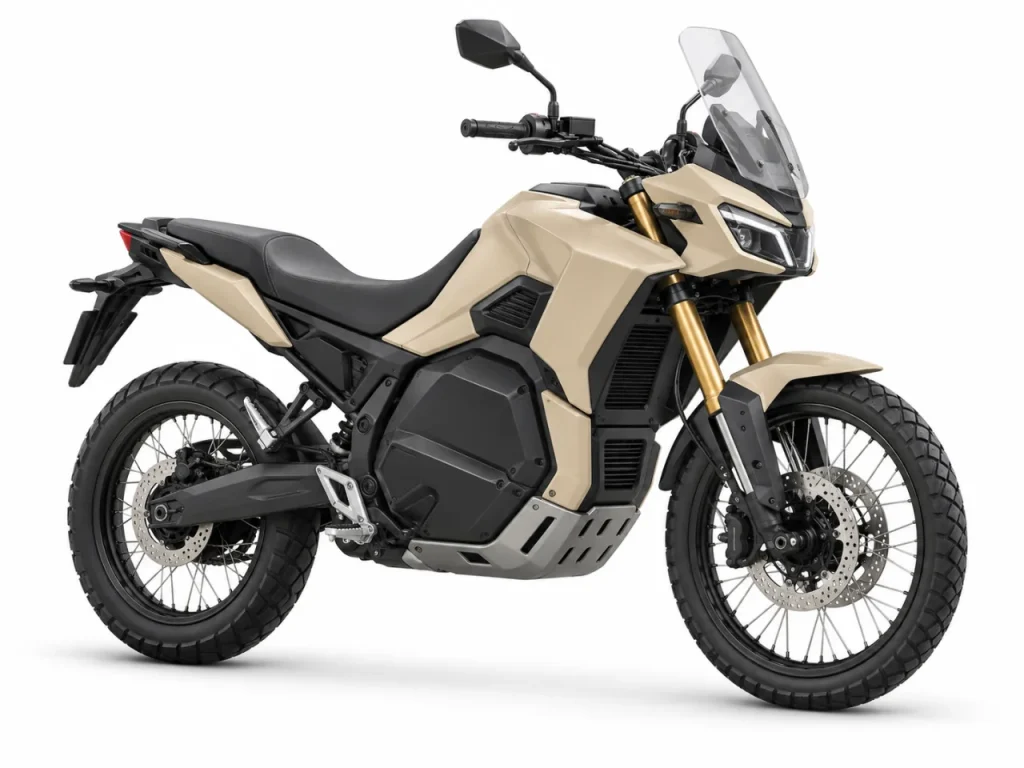
This is an original planning framework with hypothetical calculations. VoltRoute has not ridden the route of any specific product or independently measured its range. The featured adventure-style vehicle is a generic illustration and does not establish that a particular model has touring equipment.
Jump to a section7 sections
Start with the exact vehicle and route
Record the motorcycle’s usable battery energy if the manufacturer supplies it, supported chargers, normal operating instructions and load limits. Gross battery capacity is not automatically usable energy. If only nominal capacity is available, do not present a precise range calculation as a verified result.
Build a route that is legally available to your vehicle and suitable for your experience. Check access restrictions for expressways and other controlled roads using the relevant road authority’s current information. A navigation app choosing a road does not establish that motorcycles are permitted on it.
Account for luggage and any pillion, and secure the load correctly. Your familiar solo urban consumption may be a poor estimate for a faster, hillier journey with extra weight. Use comparable recorded rides when available; otherwise treat the first trip as uncertain and choose shorter legs with more alternatives.
Verify charging compatibility before choosing stops
For each proposed location, identify the exact charging equipment and confirm that the manufacturer supports it for your motorcycle. Ask about access hours, current availability, payment or app requirements, parking and whether advance permission is necessary. A photograph of a socket or a connector name is insufficient on its own.
Manufacturer-approved portable equipment can also be model-specific. For example, the official Ultraviolette Boost product page describes a particular charger; its existence is not evidence that it works with every electric motorcycle or every electrical supply.
Where portable charging is supported, confirm a suitable installation and permission with the location beforehand. Follow the vehicle and charger instructions. Do not use improvised adapters, bypass protective equipment or assume that any domestic outlet is suitable.
Calculate the energy available for one leg
A transparent planning equation is:
Planned distance = usable battery energy in kWh × planned state-of-charge difference × 1,000 ÷ expected consumption in Wh/km.
Consider an entirely hypothetical motorcycle with 8 kWh of usable energy. You plan to leave a stop at 80% and arrive at 20%, allocating 60 percentage points to the leg. That represents 8 × 0.60 = 4.8 kWh. At an assumed 60 Wh/km, the arithmetic gives 80 km.
If consumption is instead 70 Wh/km, the same allocation gives about 68.6 km. This difference illustrates why a route should not depend on one optimistic number. Neither value is a promised range, a recommended universal reserve nor a specification for a real motorcycle.
| Hypothetical input | Case A | Case B |
|---|---|---|
| Usable battery energy | 8 kWh | 8 kWh |
| Departure / planned arrival | 80% / 20% | 80% / 20% |
| Energy allocated to leg | 4.8 kWh | 4.8 kWh |
| Assumed consumption | 60 Wh/km | 70 Wh/km |
| Calculated distance | 80 km | About 68.6 km |
Choose reserve according to the route, reliable alternatives, conditions and manufacturer guidance. Preserve enough flexibility to respond to a closed charger or a diversion. Do not use the calculation to justify continuing towards an uncertain stop as charge falls.
Plan the whole day, including charging and rest
A simple energy divided by power calculation is only a starting estimate for charging time. Delivered power may be constrained by the motorcycle, charger, supply, temperature and charging stage. A published peak rating does not mean the battery receives that power continuously.
For illustration, adding 3 kWh at an average of 1.5 kW reaching the battery would take two hours. That assumption already specifies average battery-side power; it is not a prediction from a charger’s label. If the average is lower, charging takes longer. Use documented charging information for the actual equipment and allow time for setup and access.
Build a timetable with riding, charger access, waiting, charging, meals and rest. Some breaks can overlap, but a queue or inaccessible socket can still extend the day. Avoid a plan whose success requires rushing, skipping rest or riding after fatigue makes concentration difficult.
Give each leg a fallback
Save a primary stop and a separately verified alternative that remains reachable under your conservative plan. Confirm support or recovery contacts and keep essential details available offline. Review mobile coverage and payment requirements instead of assuming an app will work everywhere.
Before leaving each stop, check actual charge, conditions and the status of the next charging location. Reassess if consumption is higher than expected. Shortening the day or changing transport is a valid result of planning; continuing merely because a route was drawn earlier is not.
Do not treat a reserve as energy already committed to the next destination. Its value lies in the flexibility it gives when assumptions fail. If there is no dependable alternative within the motorcycle’s practical reach, reconsider that part of the route.
Use a compact trip worksheet
- Leg: start, destination, legal route and distance including likely detours.
- Energy: expected consumption, departure charge and chosen arrival reserve.
- Charging: exact supported equipment, permission, opening hours and payment.
- Fallback: verified alternative and a point at which you will reassess.
- Time: riding estimate, access allowance, charging window and rest.
- Conditions: weather, road changes, load and any reason to shorten the leg.
After the trip, record actual distance, charge changes, conditions and charging time. A few comparable journeys can improve your own planning, but keep the circumstances attached to the numbers. Read our motorcycle buying guide before selecting a vehicle around occasional long trips, and our charging guide for everyday arrangements.
Sources and research notes
The manufacturer charger reference was checked on 26 October 2026. Numerical examples are original hypothetical calculations, not product performance claims. Reconfirm equipment compatibility, road access and charging availability before departure.