A quick acceleration run tells you little about pushing a motorcycle out of a cramped parking space or spending an hour in traffic. A useful test ride starts with your own route, body position and charging arrangement. This checklist turns a dealership visit into a repeatable comparison without pretending that a short ride is a comprehensive review.
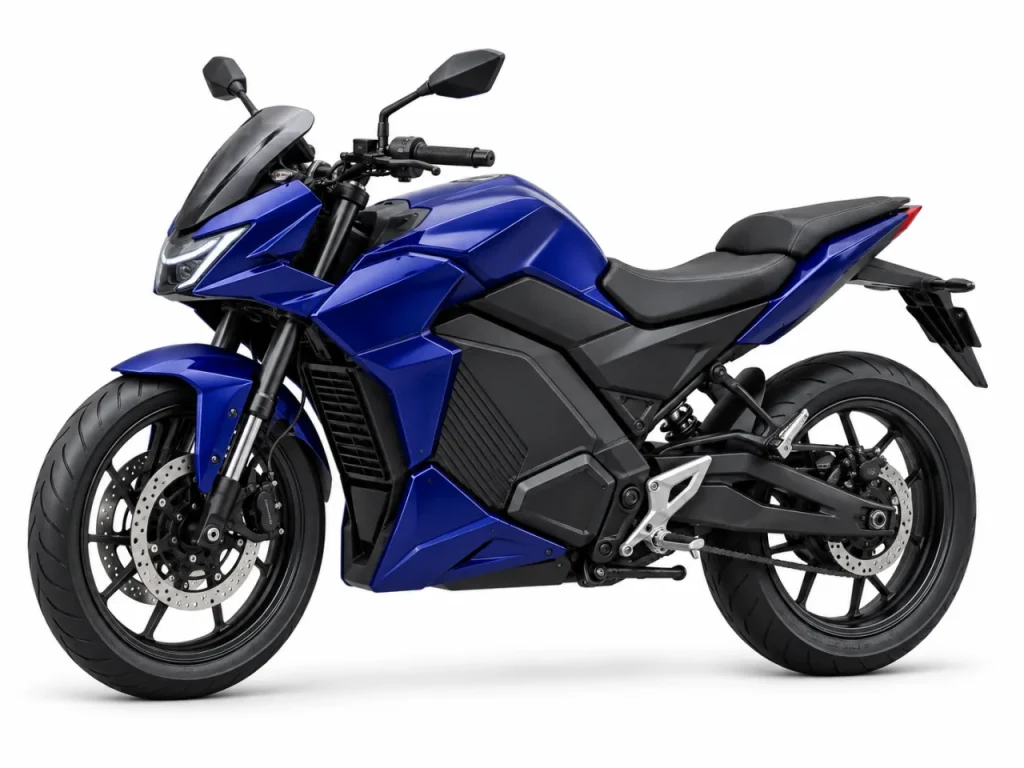
VoltRoute has not conducted the test rides described here. The checklist is a decision framework, and its image shows a generic motorcycle rather than a particular product.
Jump to a section8 sections
- Book the vehicle you are actually considering
- Check stationary fit before the motor is enabled
- Get a clear control briefing
- Use a legal, ordinary route
- Separate useful observations from unsupported conclusions
- Ask for a charging and ownership demonstration
- Use a comparison sheet that reflects your priorities
- Sources and research notes
Book the vehicle you are actually considering
Confirm the model, variant, seat configuration and available demonstration time. Different equipment or software settings can change the experience, so note any differences between the demonstrator and the motorcycle in the quotation. Ask whether the route includes the kind of riding you need to assess and whether a second visit is possible.
Check the dealer’s licence, identification, age, booking and protective-equipment requirements in advance. Revolt’s official first-time test-ride guide is one manufacturer example; confirm the actual arrangements with your chosen outlet.
Read any test-ride agreement before signing. Understand the permitted route, supervision and your responsibilities. Bring appropriate riding protection and postpone the demonstration if weather or traffic makes it unsuitable. A purchasing decision does not justify riding beyond your experience.
Check stationary fit before the motor is enabled
With dealer assistance, sit in your normal riding position and assess reach to the handlebar, levers and foot controls. Ask for any permitted adjustment before judging the position. Check whether you can operate the controls without stretching or looking away for an extended period.
Evaluate support at stops and the effort needed to hold the motorcycle upright. Seat height alone does not describe this: seat width, suspension position, your footwear and weight distribution matter. There is no universal requirement that every rider flat-foot every motorcycle, but you need a stable, confident arrangement appropriate to your ability.
- Try a supervised parking manoeuvre with the vehicle safely configured as the dealer instructs.
- Assess pushing effort and handlebar clearance where your real parking space is tight.
- Check whether clothing or luggage interferes with steering and controls.
- If you regularly carry a pillion, arrange an explicitly permitted assessment instead of guessing from seat length.
Get a clear control briefing
Ask the dealer to demonstrate start-up, readiness indications, shutdown, riding modes, regeneration settings and any reverse or parking-assist function fitted. Do not assume the controls operate like those on another electric motorcycle. Understand how to make the vehicle safe before dismounting.
Locate the warning lights and ask what requires you to stop. Learn the normal operation of both brakes before moving. Ask how power delivery changes with the selected mode and whether any setting behaves differently at low charge or under particular operating conditions.
Choose an appropriate familiarization setting and make one change at a time, following the briefing. Testing the highest performance setting immediately can conceal the ordinary low-speed behaviour that matters most on a commute.
Use a legal, ordinary route
Begin gently in the agreed area. Check smooth pull-away, predictable response at low speed, comfortable turns and normal stops. Look for whether you can maintain a steady pace without excessive effort or repeated correction. Stay within the law and the dealership’s permitted conditions throughout.
On suitable sections, assess normal road imperfections, visibility through the mirrors, display readability and the riding position. Avoid deliberate emergency-braking drills, traction-limit experiments or stunts on public roads. The purpose is to see whether you can use the motorcycle comfortably, not to provoke its safety systems.
Record the route and conditions immediately afterwards. “Comfortable for 12 minutes on a smooth road” is more useful evidence than “comfortable for touring.” If your usual journey is much longer, ask about a longer authorized demonstration or another way to evaluate fit.
Separate useful observations from unsupported conclusions
A short ride can reveal an awkward lever reach, hard-to-read display or uncomfortable knee angle. It cannot establish battery degradation, annual maintenance cost or reliable highway range. A displayed range estimate may reflect earlier riding and operating conditions.
Record starting and ending charge if useful, but do not extrapolate a few minutes of riding into a precise full-charge distance. Battery displays have limited resolution, and the route may be unlike yours. Use the range-planning framework to understand energy, reserve and route assumptions, then seek evidence relevant to the exact motorcycle.
Ask for a charging and ownership demonstration
Have the dealer show the approved charger, connection sequence and storage arrangement. Identify the equipment included in the quote and what costs extra. Check whether it fits your parking setup and whether an installation assessment is needed.
Ask how the motorcycle reports charging status and faults, and what you can do if the app or mobile network is unavailable. For public charging, confirm the exact supported equipment; connector appearance alone does not prove compatibility. Keep the manufacturer’s written instructions rather than relying on a verbal promise.
Get the service location, appointment process and recovery arrangements in writing. Our motorcycle buying guide and battery-warranty guide provide a fuller ownership checklist.
Use a comparison sheet that reflects your priorities
| Decision area | What to record | What remains unproven |
|---|---|---|
| Fit and parking | Reach, support at stops, pushing effort | Comfort over a much longer journey |
| Controls | Normal response and ease of operation | Behaviour in untested conditions |
| Daily route | Roads, duration and traffic actually experienced | Performance on a different route or load |
| Charging | Demonstrated equipment and installation requirements | Availability at an unverified public location |
| Ownership | Written quote, terms and support contacts | Future reliability and resale value |
Mark each area “works for me,” “needs another check” or “does not meet my needs.” These are your observations, not a published product rating. Resolve an important uncertainty before making a deposit, and read the cancellation terms before paying.
Sources and research notes
The linked manufacturer booking reference was reviewed on 26 October 2026. Dealer requirements and available demonstrators can change. This guide does not claim a personal test ride, measured performance result or recommendation of a specific motorcycle.