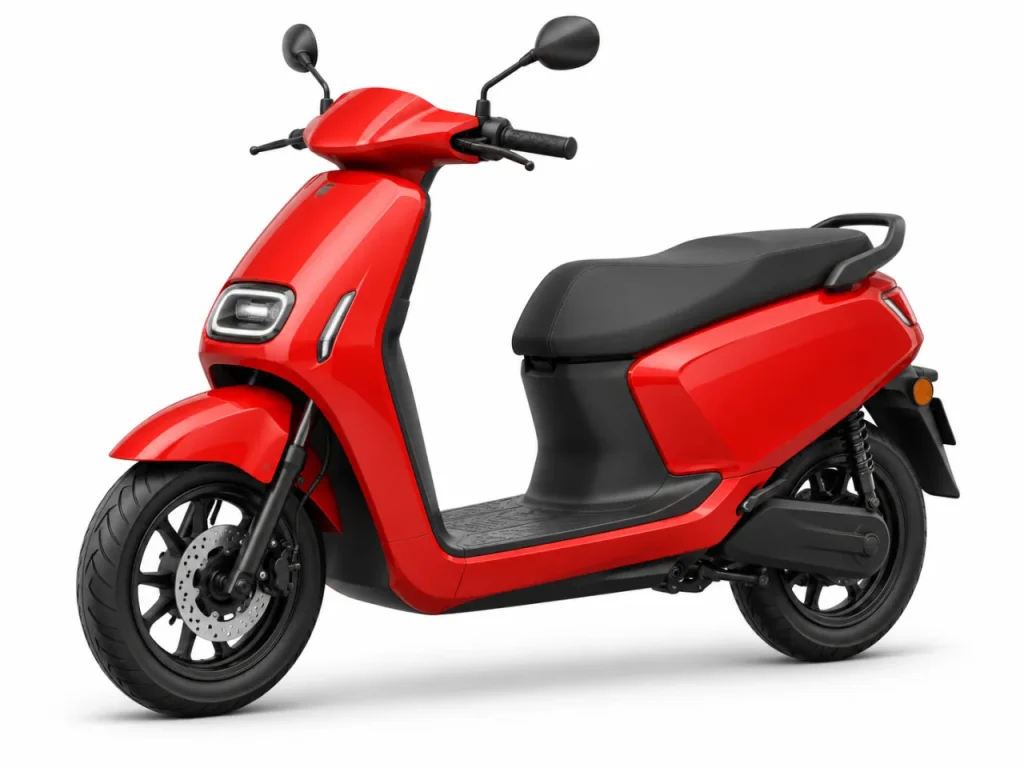
Choose an electric scooter only after you can answer three questions: where will it charge, how much distance must it cover between reliable charging opportunities, and who will repair it locally? A larger battery or a higher advertised range cannot compensate for an unusable parking arrangement.
An electric scooter can make a predictable daily journey inexpensive and convenient. It can also create a surprisingly awkward routine if the charger is in the wrong place, the rider cannot comfortably move the scooter backwards, or the nearest authorised workshop is difficult to reach. This guide is a practical shopping framework for India, rather than a ranking based on specifications we have not road-tested.
The aim is to leave a showroom with comparable written information. You should be able to describe your route, identify the exact battery and charger variant, explain the on-road quotation and understand what happens if the vehicle stops working. Those details remain useful after a launch offer has disappeared.
Jump to a section8 sections
- Write a one-week travel brief before looking at models
- Solve charging before paying a booking amount
- Compare range on the same basis
- Make the test ride answer everyday questions
- Turn the advertised price into a comparable quotation
- Read the battery warranty as a contract
- Make the final decision with three scenarios
- Before delivery: a compact handover check
1. Write a one-week travel brief before looking at models
Record a normal working week: the return commute, shopping detours, school runs, weekend visits and the journeys on which you regularly carry a passenger. Distinguish a comfortable average day from the longest day you expect the scooter to handle without depending on an uncertain public charger. Also note whether the road is slow urban traffic, a sustained faster corridor or a route with substantial climbs.
For an illustrative household, the office return journey might be 28 km, the school detour another 8 km and occasional errands 6 km. That is a 42 km demanding day, even though the owner describes the commute as “only 14 km.” Add a deliberate reserve for diversions and an unavailable charger. The reserve is your planning choice, not a universal percentage guaranteed by a manufacturer.
Write down where the vehicle is parked during the day and at night. A charging location that is available only when another car moves is not equivalent to an assigned, accessible socket. If two people will share the scooter, include both riders in this exercise.
2. Solve charging before paying a booking amount
Bring the exact charger specification to the person assessing your parking supply. Socket requirements vary by model: Ather describes its Duo as a portable or mounted charger for a 6A three-pin socket, while other scooters specify different equipment. That is an example of why “any household socket” is too vague as a purchasing plan. Read the manufacturer’s charger description and the manual for the vehicle actually quoted.
For an apartment, discuss permission, cable routing, metering, protection from rain, access control and who pays the electricity bill. Use a competent electrician to assess the circuit and protective devices. Do not let a purchase decision depend on a loose extension lead stretched across a corridor or on an informal promise that a common-area socket will always be available.
A removable battery may solve some access problems, but first try the actual lifting and carrying routine. Check the pack’s stated weight, the number of packs, the locking mechanism and the approved indoor charging arrangement. “Removable” describes a design feature; it does not automatically mean comfortable to carry up several floors every day.
3. Compare range on the same basis
Ask whether a number is a certified test-cycle figure, a manufacturer road estimate or a measurement from an independent ride. Do not place them in the same comparison column without labels. Battery size, rider and passenger load, speed, road gradient, wind, tyre pressure, ambient conditions and the selected mode can all change the energy needed for a journey.
There is no reliable universal rule that every scooter delivers a fixed percentage of its advertised range. A short test ride also cannot validate a full-battery range claim. Use it to assess comfort and control, then build a conservative route plan using evidence that matches your likely conditions. Our range guide shows how to separate battery energy, consumption and reserve.
| Ask the dealer | Why the answer matters | What to keep |
|---|---|---|
| Exact model, battery and model year? | A familiar family name can cover different hardware. | Variant code and dated specification sheet. |
| Which range standard and riding mode? | Unlike test conditions produce misleading comparisons. | The labelled claim and its footnotes. |
| Which charger is supplied? | Charging time depends on equipment as well as the battery. | Charger rating, socket requirements and inclusion in the price. |
| What works without a subscription? | Connected features may have recurring costs. | Included period and renewal terms. |
| Who handles local warranty repairs? | Sales presence does not establish workshop capability. | Authorised service location and escalation route. |
4. Make the test ride answer everyday questions
Use a permitted route and obey local traffic rules. Start with the scooter powered off: can you lift it off the stand, balance it while turning the handlebar and push it backwards on level ground? Check the reach to the ground, the brake levers and the controls while wearing your normal riding equipment. A seat that is comfortable for five minutes may still place your knees awkwardly on a longer commute.
Then evaluate predictable starts, slow-speed turns, normal braking and the transition between acceleration and regeneration. If the manufacturer permits a passenger and you regularly carry one, include that use with the dealer’s permission. Check the load limit first. Judge whether the passenger has usable footrests and a secure seating position rather than simply whether two people can fit.
Try your actual helmet in the storage compartment. Check charging-cable storage, bag hooks, opening mechanisms, mirrors and display readability. Confirm that essential operation remains practical if your phone has no battery or mobile data. These are ordinary ownership questions, not evidence that one brand is universally better.
5. Turn the advertised price into a comparable quotation
Ask for an itemised on-road quote with a validity date. Separate the vehicle price, taxes where applicable, registration-related charges, insurance, charger, installation, accessories, connected-feature packages and optional warranty. Identify discounts and government incentives individually. A low headline figure may include a benefit for which your exact vehicle or purchase is not eligible.
Compare quotations using the same insurance cover and the same accessories. If finance is offered, compare the total amount payable, down payment, processing charges and any compulsory bundled products rather than the monthly instalment alone. This site does not provide an individual loan recommendation; the practical goal is to avoid mixing a cash quotation with an incomplete finance advertisement.
Do not subtract a claimed subsidy twice. A displayed effective price may already include it. Before paying, use our dated PM E-DRIVE guide and ask the dealer to identify the applicable line on the invoice.
6. Read the battery warranty as a contract
Find separate terms for the traction battery, vehicle, charger, auxiliary battery and wear items. Identify the time and distance limits, which limit applies first, any state-of-health threshold, scheduled-service conditions, exclusions and whether the cover transfers to another owner. A long optional warranty is not necessarily included in the base vehicle price.
Ask what a successful claim can provide: repair, module work, a replacement pack or another remedy under the policy. Also ask about transport to the service centre and the availability of a temporary vehicle. Neither should be assumed. Save the dated policy and any purchased add-on certificate with the invoice; our battery warranty worksheet explains the questions in more detail.
7. Make the final decision with three scenarios
First test the easy scenario: your normal commute with home charging. Then test a difficult but plausible week: additional journeys, a missed charging session and a passenger. Finally consider a disruption: the scooter needs an authorised repair and you must use another form of transport for several days. If the purchase only works financially or practically in the easiest scenario, change the shortlist or postpone the decision.
Use the running-cost calculator for an energy estimate, then add your actual insurance, finance, maintenance and subscription costs separately. A useful purchase decision is one you can explain without relying on the longest range number or the biggest discount banner.
Before delivery: a compact handover check
- Match the model, VIN/chassis details and battery configuration to the invoice and registration documents.
- Inspect the body, tyres, lights, controls, charging connector and supplied equipment before accepting delivery.
- Ask the dealer to demonstrate normal charging with the supplied charger and explain warning indicators.
- Complete the account handover, keep spare keys or access devices and confirm the recovery procedure.
- Save the owner’s manual, service schedule, warranty certificate, payment records and local service contacts.
These checks do not replace a professional inspection. They give you a clear record of what was purchased and demonstrated, making the first weeks of ownership easier to manage.
Research checked 26 October 2026. Manufacturer examples illustrate questions to ask, not endorsements or road-test results. Model specifications and local quotations can change.